Saint Panteleimon: The Merciful Healer and Martyr
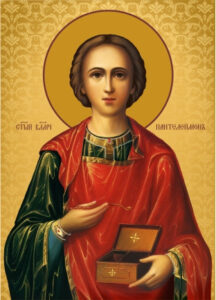
Saint Panteleimon, the great martyr and healer, was born in the city of Nicomedia into the family of a noble pagan named Eustorgius. At birth, he was named Panteleon. His mother, Eubula, was a Christian and desired to raise her son in the Christian faith. However, she passed away while Panteleon was still a young boy. His father enrolled him in a pagan school, and upon completing his studies, he began to learn the art of medicine under a renowned physician in Nicomedia, Euphrosynus. His medical talents soon became known to Emperor Maximian, who wished to have him as a doctor at his court.
At that time, three Christian presbyters – Hieromartyrs Hermolaus, Hermippus, and Hermocrates – were secretly living in Nicomedia, having survived the burning of 20,000 Christians in the Nicomedian church in the year 303. One day, Father Hermolaus invited the young man to his home and spoke to him about the Christian faith. From that moment on, Panteleon visited Hermolaus daily.
One day, the young man encountered a dead child in the street who had been bitten by a viper, which was still lying nearby. Panteleon prayed to the Lord for the child’s resurrection and the destruction of the venomous serpent. He made a firm vow that if his prayer were answered, he would become a follower of Christ and receive Baptism. The child came back to life, and the viper was torn to pieces before Panteleon’s eyes.
Following this miracle, Panteleon was baptized by Saint Hermolaus and received the Christian name Panteleimon, meaning “all-merciful.” He then began to speak to his father about the Christian faith, preparing him for baptism. When Eustorgius witnessed his son heal a blind man in the name of Jesus Christ, he believed and was baptized along with the man who had regained his sight.
After his father’s death, Panteleimon dedicated his life to healing the sick, the poor, and the needy. He healed them selflessly, invoking the name of Jesus Christ. His fame as a merciful physician soon spread throughout the entire city.
However, jealous pagan doctors reported to Emperor Maximian that Panteleimon was healing imprisoned Christians. The emperor summoned him and tried to persuade him to renounce his faith and offer sacrifices to the idols. However, Panteleimon openly confessed himself as a Christian and, before the emperor’s very eyes, healed a paralyzed man in the name of Jesus Christ. Enraged, Maximian executed the healed man for glorifying Christ and subjected Panteleimon to brutal torture.
By the emperor’s command, Panteleimon was thrown to wild beasts in the circus, but instead of attacking him, the animals licked his feet and gently nuzzled his hands. The spectators rose from their seats and began to shout: “Great is the God of the Christians!” Enraged, Maximian ordered the execution of all who had praised Christ and commanded that Panteleimon be beheaded.
As the great martyr prayed, a soldier struck him with a sword, but the blade became as soft as wax and did not harm him. When he finished his prayer, a heavenly voice called him to the Kingdom of Heaven. The executioners fell to their knees, seeking forgiveness. They refused to carry out the execution, but Panteleimon himself ordered them to fulfill the emperor’s decree. With tears in their eyes, the soldiers bade him farewell.
When he was finally beheaded, milk flowed from his wound instead of blood. The olive tree to which he had been tied suddenly bore fruit at the moment of his death. Many who witnessed this miracle believed in Christ.
His body was cast into a fire, but it remained unharmed and was reverently buried by Christians.