
Saint Mercury: The Warrior of Christ
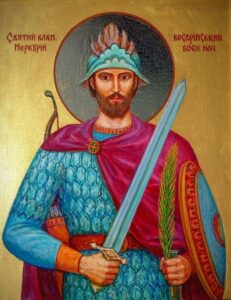
Saint Mercury, of Scythian origin, served as a soldier in the Roman army. He lived during the time when Emperors Decius and Valerian issued a decree requiring all Roman citizens to worship pagan gods and sentencing Christians to death. At that time, the Roman Empire was attacked by barbarians, and Emperor Decius set out on a campaign with a large army.
During one of the battles, the Angel of the Lord appeared to Mercury, handed him a sword, and said: “Do not be afraid, go boldly against the enemy. When you achieve victory, do not forget your Lord God.” Mercury displayed extraordinary bravery in battle, defeating many enemies, including the barbarian king himself, thereby securing victory for the Romans. Grateful for this triumph, the emperor generously rewarded Mercury and promoted him to the rank of general.
Later, the Angel appeared to Mercury once more, reminding him by whose power victory had been granted and calling him to serve the Lord. Mercury remembered that his father had been a Christian, so he received baptism himself and refused to participate in the ceremonial sacrifices to the pagan gods. When he was brought before the emperor, he openly professed his Christian faith, threw his military knightly belt and general’s mantle at the ruler’s feet, and renounced all honors.
Mercury was subjected to cruel tortures – he was stretched over fire, cut with knives, and beaten with whips so brutally that his blood extinguished the flames. However, each time he was left dying in prison, he was miraculously healed by the Lord. Eventually, the courageous warrior and steadfast Christian was beheaded in Caesarea of Cappadocia. After his death, his body exuded a fragrant aroma of myrrh and incense, healing many sick people.
All the soldiers of Mercury’s regiment also perished. When the commander-in-chief ordered them to renounce Christ, six thousand men humbly bowed their heads, knelt, and were slaughtered. Many centuries later, Metropolitan Vasyl Lypkivsky reflected on this event, stating:
“This was not a surrender, nor passive submission to physical force. It was the most active moral victory – not only for this regiment but for all of Christianity – a triumph of spirit over flesh. They achieved a victory that did not lead to revenge or hatred, but to compassion and love.”
A legend tells that even after his death, Mercury helped to free the world from the persecutor of Christianity, Emperor Julian the Apostate (361-363). Saint Basil the Great prayed before an icon of the Most Holy Theotokos and the Great Martyr Mercury for deliverance from Julian. At the very moment when Julian was fighting the Persians, Saint Basil saw that the image of Mercury on the icon suddenly disappeared and then reappeared, now holding a bloodstained spear. At that exact moment, Julian was struck by a spear from an unknown warrior on the battlefield, who vanished immediately after. As he lay dying, Julian realized that it was a defender of the Christian faith and, in his final moments, uttered: “You have conquered, Galilean!”