
The Life of Saint Cyprian and Saint Justina
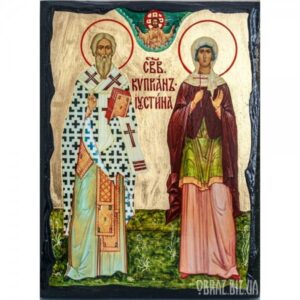
Saint Cyprian lived in the 3rd century AD. He was born and resided in Antioch, and before his conversion to Christ, he was a renowned magus. From a young age, he devoted himself to the study of philosophy and the mystical arts. To perfect his knowledge of the occult sciences and magical practices, he traveled through Asia, Greece, and Egypt, learning from the most famous pagan priests and magi. To study astrology, he sought out the Chaldeans and, having learned their secrets, returned to his native city of Antioch.
Settling there, Cyprian began to demonstrate the wonders of his mystical abilities, applying the skills he had acquired during his travels. He also started teaching others the secrets of this art. Soon, he became famous in his city; all the pagans regarded him with both respect and fear. Many sought his assistance for various purposes – some for lust, others for revenge, and still others for theft, among other things.
At that time, there lived in Antioch a pagan priest named Edesius, who had a wife and a daughter named Justina. Justina, having learned about Christian teachings by chance, converted and was baptized. She also brought her parents to Christ. Being exceptionally beautiful, she attracted the attention of a wealthy young pagan named Aglaias. He persistently asked her to marry him, but Justina, having devoted all her love to Christ, refused to wed a pagan and carefully avoided even meeting with him. Her rejection only inflamed Aglaias’s passion further, and he pursued her in every possible way but was unable to succeed.
Desperate, he turned to the famous magus Cyprian, pleading with him to use his mystical arts to turn Justina’s heart toward him. Eager for a generous reward, Cyprian employed all the means at his disposal, drawing on his vast knowledge of sorcery to compel Justina to accept Aglaias. However, all his enchantments proved fruitless. Strengthened by her love and devotion to the Lord, Justina remained unwavering.
Meanwhile, a plague struck the city, and rumors spread that Cyprian, the mighty magus who had failed to bewitch Justina, was seeking revenge on the entire city by bringing a deadly disease upon its people. The citizens turned to Justina, begging her to appease the magus by agreeing to marry Aglaias. Yet Justina stood firm in her decision. She reassured the people, promising them divine assistance and a swift deliverance from the plague. Indeed, as soon as she prayed with a pure heart to God, the disease subsided.
Thus, the powerful pagan magus was shamed by the humble Christian maiden. But this defeat led to Cyprian’s salvation. It forced him to reflect on whom he had truly been serving. He realized that there was something greater than his knowledge, his mystical arts, and the dark forces he had relied upon. He understood that all of it was nothingcompared to the power of the God whom Justina worshiped.
Reaching this conclusion, he sought out the Christian bishop Anthimus, confessed his errors and delusions, handed over all his harmful books to be burned, and, after being instructed in the truths of the Christian faith, received Holy Baptism. A year later, he was ordained a priest, and in time, he became a bishop. Justina, in turn, was consecrated a deaconess and placed in charge of a Christian community of virgins.
In 304 AD, Saint Cyprian and Justina were martyred for spreading and strengthening the Christian faith.
Thus, when the faithful turn to Saints Cyprian and Justina in prayer for protection against evil sorcery, they do so with the understanding that these saints are particularly able to offer such help. Justina successfully resisted all magical enchantments in her lifetime, and Cyprian, who had once mastered every secret of the mystical arts, is now able – even after death – to thwart all the deceptions and snares of the dark forces.